


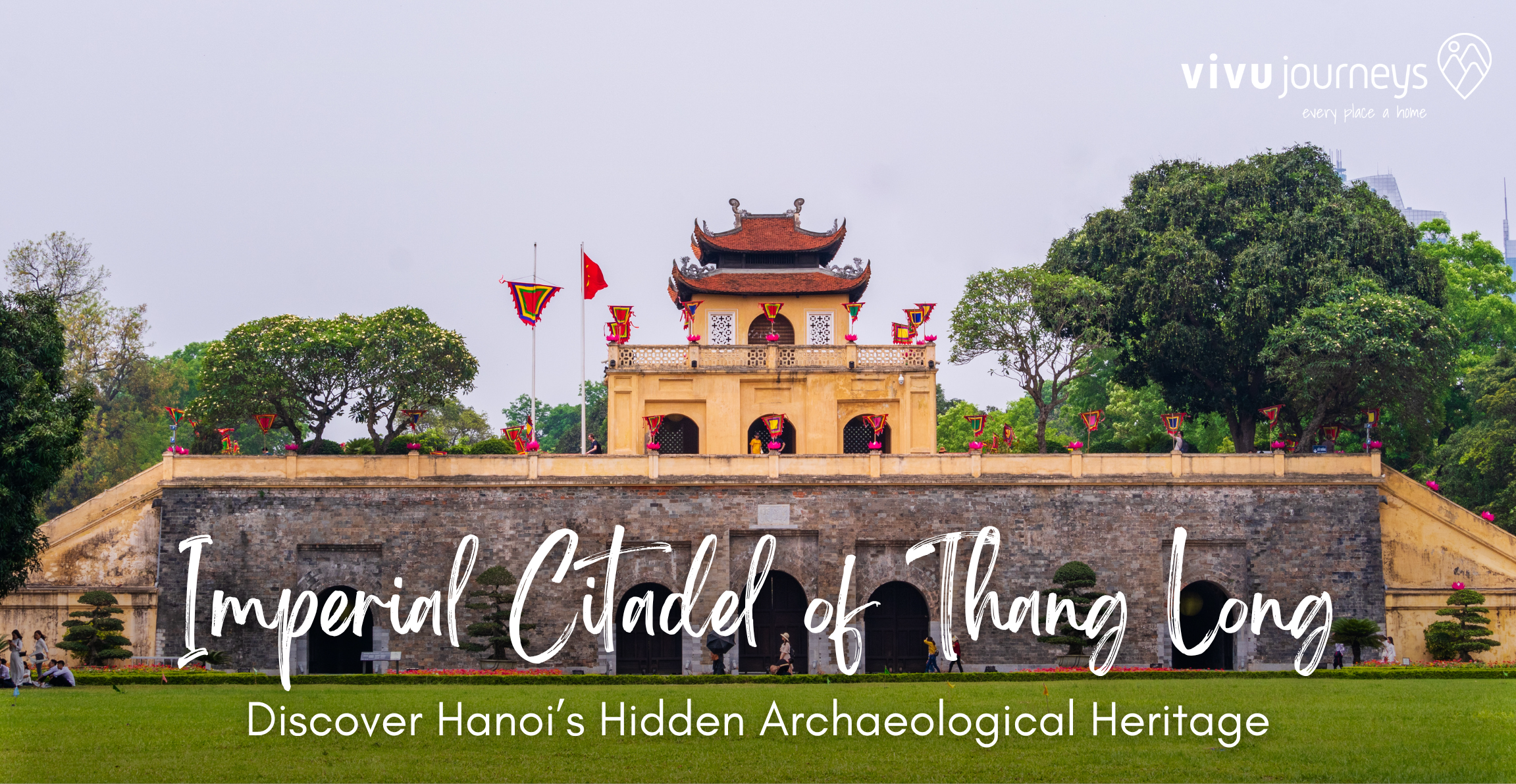
Beneath the bustling streets of Hanoi, the Imperial Citadel of Thang Long preserves one of Vietnam’s most important archaeological sites. In 2002, excavations at 18 Hoang Dieu uncovered thousands of ancient relics hidden underground, including palace foundations, old wells, ceramics, and traces of royal architecture. These discoveries revealed the ancient appearance of Thang Long, Vietnam’s former capital, and showed how the city developed as the country’s political and cultural center for more than 1,000 years.
1. The 2002 Excavation That Revealed Ancient Thang Long
At first, archaeologists only planned to search for additional relics from the Nguyen Dynasty. However, as excavations continued at the Thang Long Citadel, they uncovered multiple archaeological layers dating back to the Ly, Tran, and Le dynasties. Palace foundations, ancient wells, drainage systems, roof tiles, and ceramic artifacts were discovered across an area of nearly 45,000 square meters, making it the largest archaeological excavation ever conducted in Vietnam. More importantly, these discoveries provided direct evidence of the continuous development of Thang Long, the ancient capital of Vietnam, from the 7th to the 19th century.

One of the most remarkable discoveries at the Hanoi Thang Long Citadel was the architectural remains from the Ly Dynasty, the period when Thang Long became the capital of Dai Viet in 1010. These discoveries not only revealed the appearance of the ancient royal citadel, but also uncovered stories of art, architecture, and royal life across different Vietnamese dynasties.
1.1. Dragon, Phoenix and Lotus Motifs

The excavation also uncovered many decorative details featuring dragons, phoenixes and lotus flowers. These were not just beautiful designs. In Vietnamese royal culture, dragons often represented royal power, phoenixes suggested grace and good fortune, while lotus flowers were linked to purity and spiritual life.
Among the most distinctive findings were Ly Dynasty dragon motifs, known for their long, flowing shape and elegant style. These details help visitors see how art, belief and royal identity were expressed through the architecture and objects of the ancient citadel.
1.2. How the Citadel Changed Over Time

The remains from the Tran and Le dynasties show that the Imperial Citadel of Thang Long continued to grow and change over many centuries. Later rulers added new buildings, repaired older structures and left behind ceramics, roof decorations, courtyard bricks, old roads and wells.
These layers help visitors understand the citadel not as one single monument, but as a living historical site shaped by different periods of Vietnamese history.
2. Visiting Thang Long Citadel Today

Today, the Imperial Citadel of Thang Long is one of Hanoi’s most meaningful cultural landmarks, offering travellers a rare opportunity to see the city through its deepest historical layers. Visitors can explore ancient gates, archaeological remains, exhibition areas and preserved relics that reveal how Thang Long developed as Vietnam’s royal and political centre over more than 1,000 years.
Learn more:
Top 5 Things to Do in Hanoi for Drink Lovers
Vietnamese Street Food You Can’t Miss
3. Conclusion
Imperial Citadel of Thang Long is more than a historic landmark. As a UNESCO World Heritage Site, it preserves palace remains, royal motifs, and deep archaeological layers that show how Hanoi evolved from Vietnam’s ancient capital into the modern city it is today.
For travellers, the Thang Long Citadel offers a quiet and meaningful way to understand Hanoi’s history, culture, and identity – right in the heart of the city.