

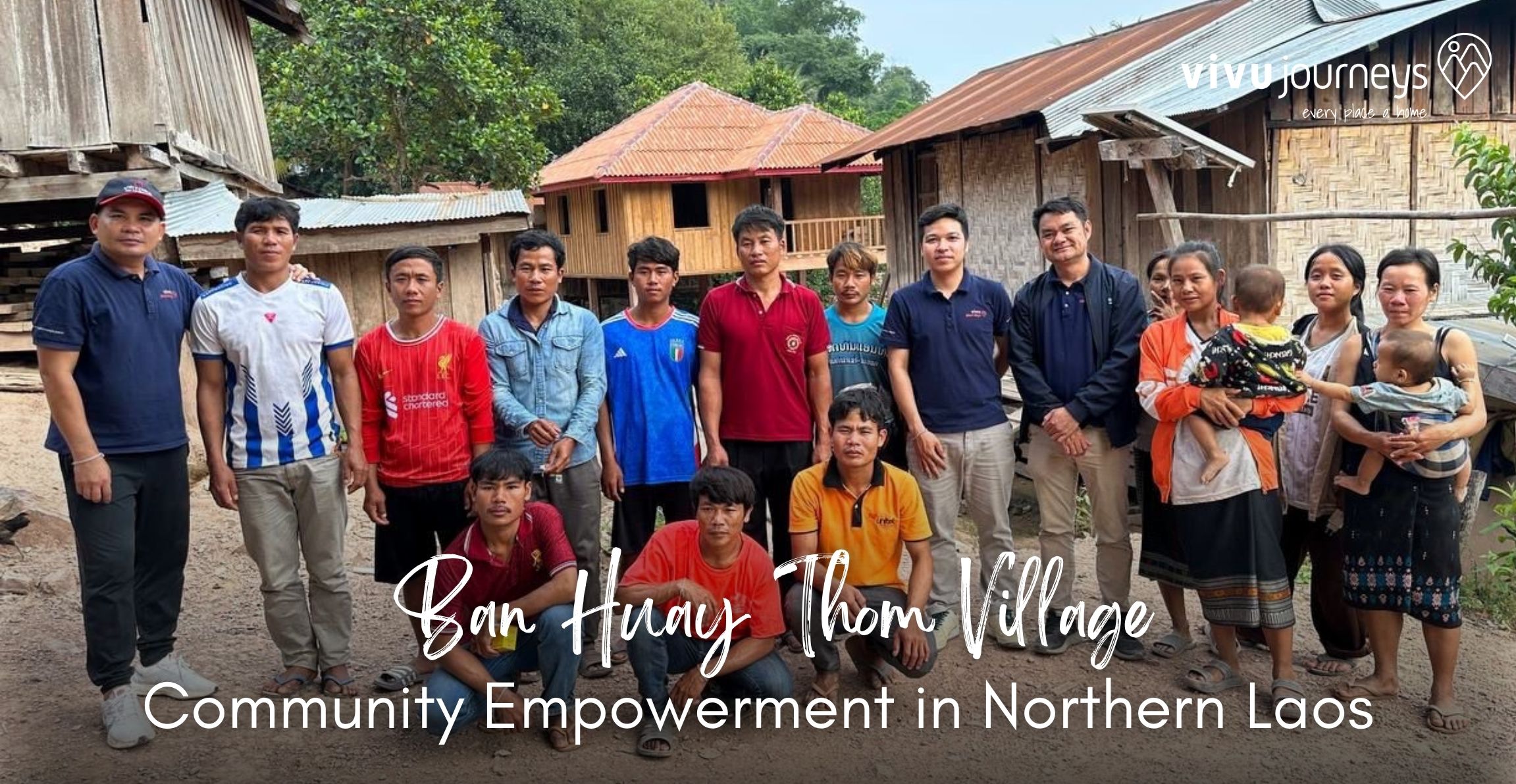
Nestled deep in the mountains of Pak Beng District, Ban Huay Thom is a quiet Khmu village accessible only by slow boat. The community lives simply, without electricity, phone signal, or running water. Community empowerment has become an increasingly important livelihood approach, supporting both individual households and shared community needs.
1. Community-Led Turning Point by Community Empowerment
The community project in Ban Huay Thom began to take shape in November 2024, when Vivu Journeys initiated hands-on training courses on cooking, cleanliness, hospitality, and food service. These sessions focused on building confidence and practical skills, helping villagers to welcome community travel guests more professionally while maintaining their traditional way of life.
From early 2025, the project entered a new phase through a collaboration with the Planeterra Project, strengthening the foundation for longer-term community development. In December 2025, this collaboration enabled the provision of essential items, including new sleeping materials, solar panels, kitchen utensils, water buckets, and other necessities.
The combination of intensive skills training and infrastructure has marked a turning point: community-based tourism has become more feasible, organized, and sustainable – while still maintaining community leadership.

Read more about our community-based projects:
- How Community Tourism Is Transforming Kok Sangke Village
- Empowering Education in Kok Sangke with Vivu Journeys Cambodia
2. What Drives Community Tourism in Ban Huay Thom
The success of community tourism in Ban Huay Thom is driven by three core pillars that reflect the village’s actual needs and capabilities. These elements form the backbone of community empowerment.
2.1. Skills Training & Empowerment
Community empowerment through practical training in cooking, cleanliness, hospitality, and operations plays a central role in professionalizing accommodation services while boosting community confidence. Instead of outsourcing services, the villagers themselves provide the experience – reinforcing ownership and ensuring tourism income remains within the community.

2.2. Infrastructure & Capacity Upgrade
Infrastructure improvements focus on comfort, safety, and capacity building – without altering the village’s traditional structure. Upgrades included new sleeping materials, solar energy installation, kitchen equipment, water tanks, and expansion of communal living spaces.

2.3. Community Empowerment through Cultural Preservation
Cultural preservation is integrated into daily life when traditional Khmu dances are supported through a community-led program, with a designated public space dedicated to cultural performances. By linking cultural activities directly to tourism income, community tourism helps protect and honor local heritage while ensuring it remains meaningful and cherished within the community itself.

3. Community Tourism Projects in Action
The Ban Huay Thom project is not just about community empowerment in a general sense, but is demonstrated through a series of concrete actions.
In November 2024, the project implemented hands-on training on cooking, cleanliness, hospitality, and food service to enhance the quality of the experience and the confidence of the community when interacting with tourists.
In 2025 alone, the community welcomed 2,932 guests, generating $34,761 in income from homestays, meals, Khmu dance performances, breakfast, and community funds. These revenues directly support households and collective needs, reinforcing tourism as a reliable livelihood channel.

These upgrades also supported the expansion of the community hall and the creation of a public space for Khmu dance performances, increasing capacity and enriching the overall visitor experience.
And most importantly, continuous improvement is essential so that community tourism doesn’t stop at a single investment. From early 2025 to the present, improvements have continued: building separate kitchens, adding dining tables, constructing bamboo walkways, and installing shoe rack areas to enhance comfort and organization for both guests and the community.
Community empowerment in Ban Huay Thom village is built through skills development, practical infrastructure, and cultural preservation, achieved through community tourism, placing local people at the center of decision-making and benefit sharing.
The project is still in its early stages, with significant potential ahead. By joining us, you will help amplify local voices and help future generations thrive in their homeland – with dignity, unity, and pride.