

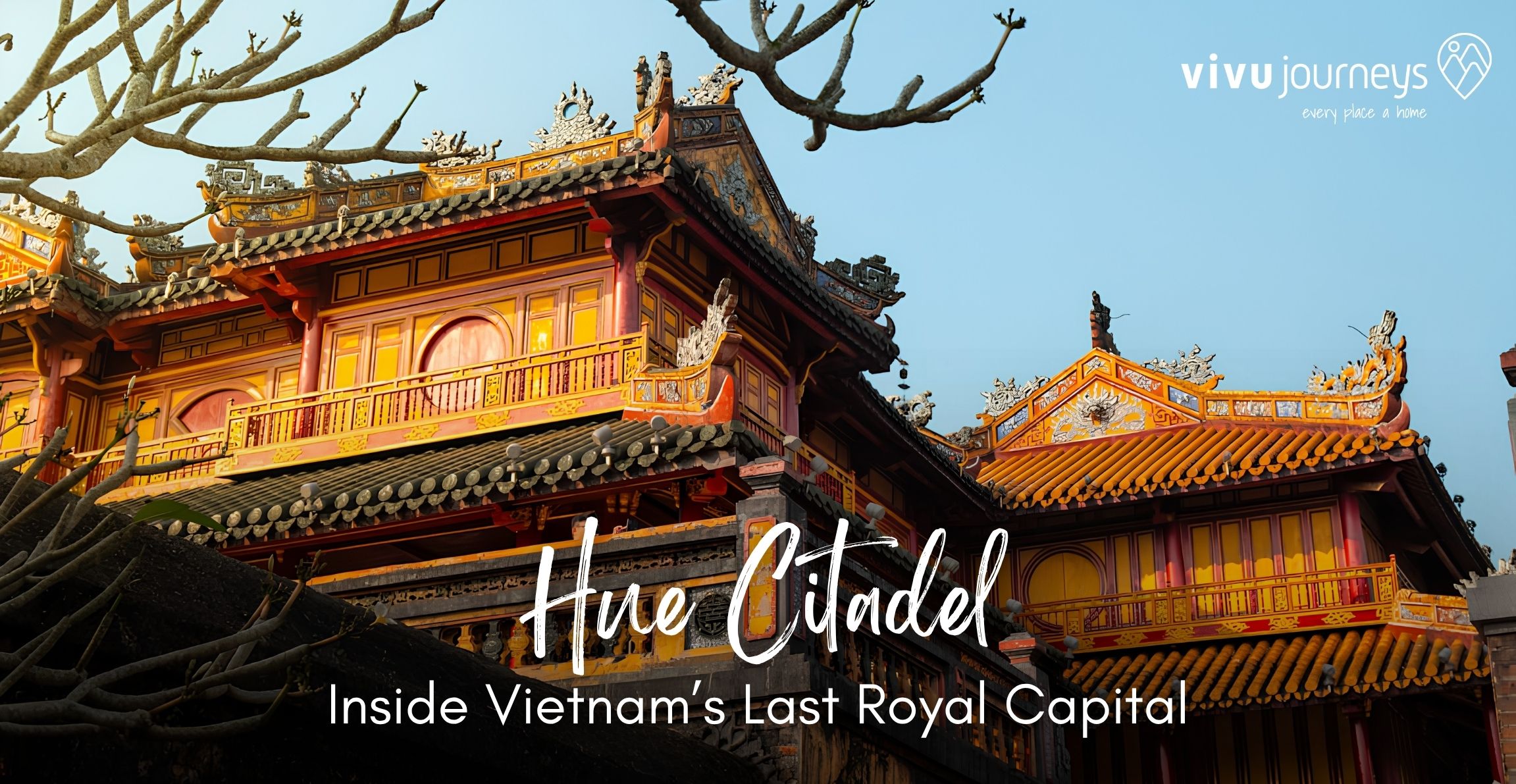
Nestled along the tranquil banks of the Perfume River in Hue, the Hue Citadel stands as the most iconic symbol of Vietnam’s imperial past. Hue Imperial Citadel in Vietnam is known for its vast complex, which once served as the country’s political, cultural, and spiritual heart during the Nguyen Dynasty. It remains one of Southeast Asia’s most compelling historical destinations, which offers travelers a rare glimpse into royal life, architectural brilliance, and centuries-old traditions.
1. The Historical Significance of Hue Citadel
The history of the Hue Imperial Citadel is a compelling story of imperial vision, wartime devastation, and cultural revival. This complex has witnessed the rise of a dynasty, the fall of a monarchy, and an inspiring journey of restoration that continues today.
1.1. Construction and The Royal Era (1804 – 1945)
The citadel of Hue was constructed in the early 19th century under Emperor Gia Long, who was the founder of the Nguyen Dynasty. Constructed by tens of thousands of workers, the citadel was completed in 1833 under Emperor Minh Mang. This ambitious project laid the foundation for the enduring history of Hue Citadel, blending Vietnamese traditions with external architectural influences.
For over a century, the citadel served as Vietnam’s political and spiritual center, home to 13 Nguyen emperors. It was here that governance, ceremonies, and royal life unfolded, defining the Hue Imperial Citadel’s history.

This era ended in 1945 when Bao Dai, the last emperor of Vietnam, officially abdicated the throne. His resignation marked the end of over a century of Nguyen rule and the conclusion of Vietnam’s imperial era.
1.2. War Damage and Restoration of Hue Citadel (1945 – present)
Following the fall of the monarchy, the citadel endured decades of conflict. In 1947, conflict between French forces and the Viet Minh caused major fires, destroying parts of the royal complex. The most severe damage came during the Battle of Hue, when intense fighting reduced much of the site to ruins. Only a fraction of its original structures survived, shaping the narrative of Hue Citadel’s Vietnam War damage.
A major turning point came in 1993, when the Complex of Hue Monuments was designated a UNESCO World Heritage Site. This recognition sparked global support for the restoration of Hue Citadel. Restoration of the Hue Citadel has since become a long-term cultural mission.

A standout achievement is the reopening of Kien Trung Palace in 2024 after extensive restoration, symbolizing the citadel’s ongoing revival. Today, the Hue Imperial Citadel stands not only as a historic landmark but as a living testament to Vietnam’s resilience and heritage.
2. Architectural Marvels at the Hue Citadel
The Hue Imperial Citadel architecture is a harmonious blend of symmetry, symbolism, and imperial authority. Within its fortified walls lie numerous palaces, temples, and gates, each serving a distinct function in royal governance and daily life.
2.1. The Overall Architectural Uniqueness
The architecture of Hue Citadel reflects a deliberate fusion of cultures combining both Eastern philosophy and Western engineering. Its outer fortress follows the Vauban style, with thick ramparts and a star-shaped defensive layout influenced by French military design. At the same time, the entire complex is aligned with Feng Shui principles. The Perfume River serves as a natural protective barrier, while Ngu Binh Mountain acts like a shield behind the citadel, protecting the imperial seat. This balance between military precision and cosmological harmony defines the enduring uniqueness of Hue Citadel.
2.2. Iconic Structures Inside the Hue Citadel
The Outer Fortress
The Hue Imperial Citadel’s outer fortress is massive, spanning nearly 10 kilometers. Its most notable features include ten fortified gates controlling access and the iconic Hue Flag Tower, a towering three-tiered structure that anchors the citadel’s facade. Built entirely with local materials, this defensive system demonstrates the scale and ingenuity of 19th-century Vietnamese construction, which was designed to withstand artillery attacks.
The Noon Gate (Ngo Mon)
The Ngo Mon Gate is the grand southern entrance to the citadel and one of its most recognizable landmarks, crowned by the elegant Five Phoenix Pavilion. Reserved exclusively for the emperor, this imposing structure symbolizes royal power and ceremonial importance. It is also the stage for important events, including proclamations and royal ceremonies.
Thai Hoa Palace
At the heart of the citadel stands the Thai Hoa Palace, where emperors held court and hosted significant state ceremonies. The palace’s ornate wooden columns, lacquered decorations, and dragon motifs embody the majesty of imperial authority.

The Forbidden Purple City (Tu Cam Thanh)
The Forbidden Purple City was once the private residence of the emperor and his family. A highlight within this inner sanctuary is Kien Trung Palace. Located toward the northern section, the palace stands out for its rare blend of Vietnamese design with French and Italian influences. Recently restored and reopened in 2024, it features vibrant ceramic mosaics and elegant European-style arches, making it one of the most distinctive structures in the Imperial Citadel of Hue.
Equally significant is the Duyet Thi Duong Theater, the oldest surviving theater in Vietnam. Its celestial-painted ceiling, designed like a miniature sky, once set the stage for royal performances, adding an artistic and cultural dimension to this secluded imperial space.
3. Signature Culture Experiences at Hue Citadel
Beyond its historical and architectural significance, the Hue Imperial Citadel complex is a vibrant cultural stage that brings history to life through festivals and immersive experiences.
The “Magical Royal Palace” Night: The “Hoàng cung Huyền ảo” experience transforms the citadel into a mesmerizing nighttime spectacle. Visitors can enjoy 3D mapping projections, illuminated installations, and reenactments of royal markets, creating an immersive journey into the past.

Ritual Reenactments: Daily activities such as the Guard Changing Ceremony at Ngo Mon Gate and traditional reenactments like the “Ban Sóc” ceremony allow visitors to witness the rituals that once defined imperial life. These experiences offer a deeper connection to the living heritage of Hue.
Royal Culinary: Step into the flavors of the imperial court by enjoying refined traditions such as royal lotus tea, once reserved for nobility. Besides, trying “cơm muối” is also a refined royal experience. Served with a variety of flavored salts, each offering distinct tastes, it is enjoyed slowly in small bites, reflecting the elegance and mindful dining culture of the Nguyen court.
Traditional Performances: Experience classical Vietnamese court music and dance at Duyet Thi Duong Theater. These performances recreate the artistic atmosphere of the Nguyen court, offering an authentic glimpse into royal entertainment.
4. Visiting Hue Citadel: Practical Guide for Travellers
The ideal time to explore Hue Citadel is from January to April, when the weather is mild, with less rainfall and moderate temperatures, perfect for walking tours and outdoor exploration. Visitors are advised to dress modestly, especially when entering sacred temples within the citadel. Shoulders and knees should be covered as a sign of respect.
The citadel is centrally located in Hue and easily accessible by taxi, bicycle, or on foot from most parts of the city. From Da Nang or Hoi An, travelers can reach Hue via train, bus, or private car through the scenic Hai Van Pass.

Beyond the citadel walls, don’t miss the chance to experience Hue’s renowned cuisine. From elegant royal dishes once served to emperors to local favorites like “bún bò Huế” and “bánh bèo”, the surrounding area offers a rich and flavorful introduction to the city’s culinary heritage. For a truly local touch, be sure to try Hue’s signature salted coffee “cà phê muối”, a unique blend of bold coffee and creamy, lightly salted foam that has become a must-try experience in Hue.
Learn more:
5. Explore Timeless Hue with Vivu Journeys
Exploring the Hue Imperial Citadel is more than a historical visit; it is a journey into the soul of Vietnam’s imperial past. At Vivu Journeys, we help travellers experience Hue beyond sightseeing – through stories, people, craft, performance, and meaningful local encounters.

For more special cultural experiences and thoughtfully curated journeys across Vietnam, enquire now or partner with us to create meaningful itineraries beyond the usual tourist trail.